Showing posts with label rain. Show all posts

The vada pav season

Monsoon has always felt like a watershed season in my life. Before I explain why, I want to mention some lucid memories of rains, chronologically; memories which I just need to close my eyes momentarily to cherish.

Kindergarten

The faintest oldest memories include heavy rain in Hyderabad as my sister and I are moving in a cycle rickshaw ridden by Ramu uncle, from our schools to hom. In a cycle rickshaw the hood being up doesn't really prevent the rain from making its presence felt especially if its even a bit windy. But worse was Ramu uncle getting completely drenched, but he seemed to not mind it!

School

Vada pav is certainly the snack of champions!
In Mumbai, when it rained, the skies came down to meet the ground. It was the kind of rain that can stop trains and shut schools. That would be the best day of my life. It felt like I had gained an extra day in my life to enjoy, play, and cherish. My fondest memory was collecting all the coins I could find around the house, inside drawers, old wallets, and in the prayer room and heading to the nearest snack shop for a steaming hot vada pav with fried chillis. Its literally the only thing that I miss of that city! 

College

In Bangalore, the rain was very well behaved; It would often stick to schedules and leave when done, no encores or unexpected downpours. You could go about doing your chores with just a raincoat or an umbrella. I don't remember a single day of college being closed due to rain, which was a pleasant expectation in Mumbai.

Later in life

In the Western Ghats, sipping tea, beer or rum with friends with a fire on the side while its raining is etched in my mind.


In Bomdo, Arunachal Pradesh, it could rain any time of the year but largely during 9 months of the year. Everyone would go about their chores with interesting rain gear, some made of bamboo and cane, some even stole my greenhouse plastic to make shelter from rain! Days were spent listening to the rain on tin roof and reading a book or writing. Or make a fire and cook a meal while having a drink since there was nothing much else to do. Weeks were spent in this way, when it felt that life and work were stuck in inertia. But those days taught me valuable lessons; to enjoy the moments when life slows down and to remain calm and occupied till it got sunny.

A Bomdo family planting rice seedlings in their jhum field in heavy rain

These days

Goa monsoons coincide with the tourist off-season; so its just wonderful. Beaches are empty and rains give me the same nostalgic vibe I used to feel in Bomdo, except there is electricity, internet, chores, and the phone! We did have a storm once though, some coconut trees broke like matchsticks! A big branch of our mango tree came down too.


Today

This year the monsoon is different though, too little rain and too late but yet the watershed moment in my life has been to be diagnosed of chondromalacia patella and meniscus tear in my knee. Remember the post in which I talked about underestimating normalcy? Well it turns out my meniscus had torn by then and I will be needing a surgery in a couple of weeks from now.

Either way, I look forward to getting the knee fixed and returning to active life within a month after the surgery. Reminiscing about the past is my favorite thing to do when its raining, which is probably clear from this post!

Things fall in place


I arrived to my study-village in Arunachal Pradesh after more than a year, hungover from times in the United States of America, and from four days spent at home in Bangalore. Resources were superfluous in the last nine months; electricity, internet, phone network, home delivery, libraries and suchlike. Here - no electricity, no phone network or internet, have to cook food on firewood and more rain than the village needs right now, life quickly slows down. And then as the feeling sets in, good things start to roll.

The first house I went to, I see a new baby born and in spite of meeting me for the first time ever, she smiled and welcomed me. I was at my old home again. The entire village was cultivating a complete new hillslope in the landscape, the previously cultivated hillslope in the foreground, its a bit like the feelings I was going through, new ones replacing the old ones which are presently fallow.


I enter the old Forest Barracks/Inspection 'Bungalow' where I've spent many months in the last five years and I now wonder how. A dark place alone where silence hangs like its part of the air here. And then I wonder, do I still remember to make a fire? So, I try to start a small fire, a single matchstick lights strips of papers light strips of bamboo light woodstrips light small logs of wood and the fire sustains. Yes, I do know how to make a fire! The first meal, Ragi (finger millet) powder in hot water, filling.


So many flowers have bloomed and ferns look healthy, its their time now what with all the play of rain and sun these days.


And on a short walk I see a white-faced Mithun (Bos frontalis) nurse her white-faced calf. Nearby, the Siang is roaring with white water with all the rain; carrying silt a thousand miles from here as well as bringing in silt from thousand miles away to here.


Back in the barracks, evening is taking away the little light available and Dungé my friend built a contraption with two batteries to light few LEDs and I have light, bamboo makes good battery slots it seems. This light lasted the two weeknights I was at Bomdo, when I read 'The Mink River' by Brian Doyle, stories from a beautiful village called Neawanaka, not very different from the village I was in. Intertwined stories of joy and sorrow of ordinary people's everyday life that are told with intricate details, and most imaginative metaphors. 


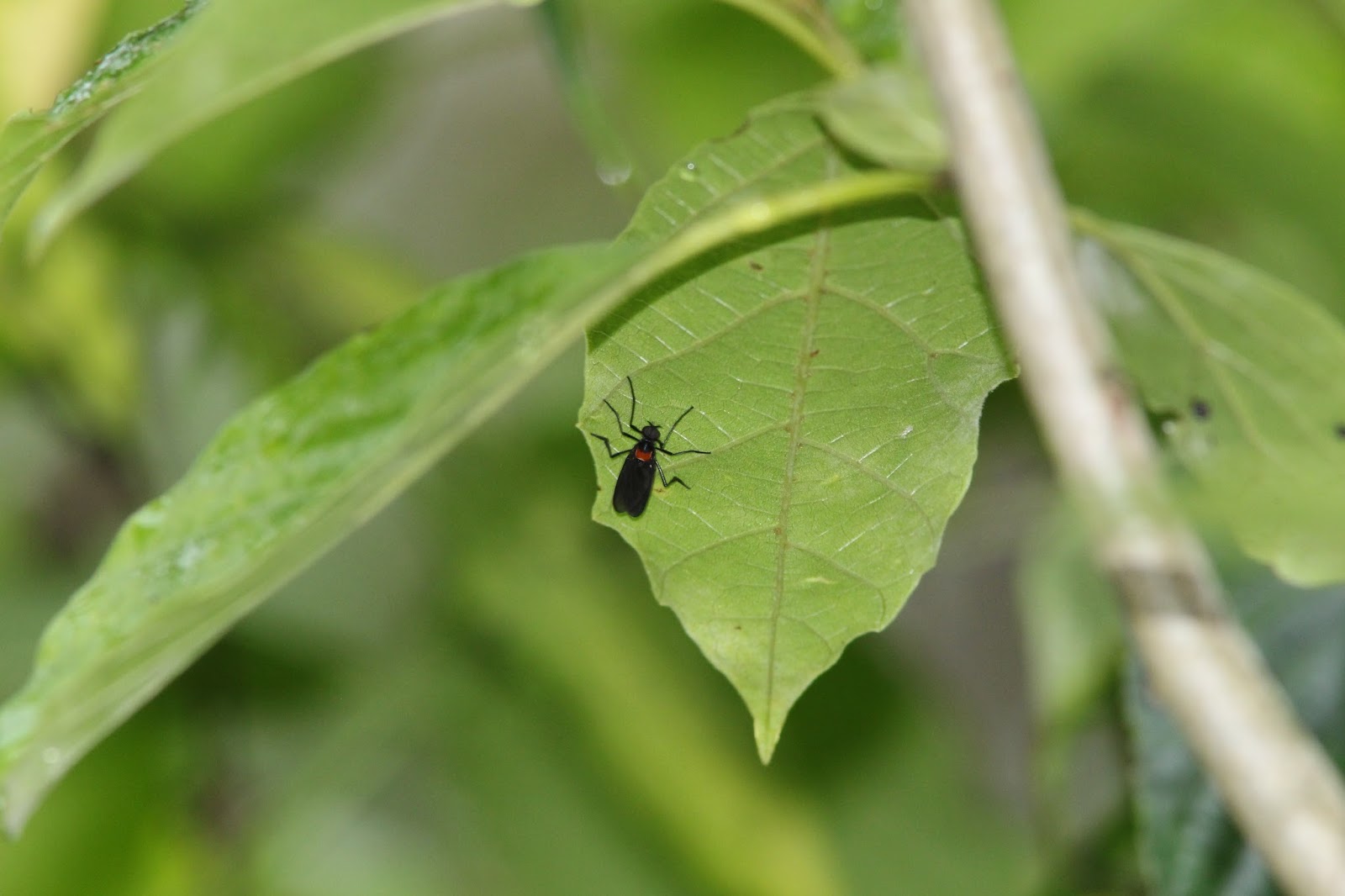
In the evening, its still raining so hard that I see a small little bug sitting motionless under a leaf-umbrella, nice choice of place for a shelter from the storm. 


The next day when the rain reduced to a spray, I took another long walk. Ricefields on the other side of Siang look like a multi-layered cake in a confectionary, either I'm hungry or I'm getting acclimatized to the loneliness, mostly the latter, I'm well-fed. 


A pill millipede anxiously crossed the road ever so slowly; its back is waterproof, and when it figures I am close enough it closes up just for a few seconds, then builds up courage and opens up again and continues its journey; we're two strangers crisscrossing that mean no harm to each other..


Back in the village, the old people are chatting as one of them is making an umbrella for the rain with cane, three layers of these to keep the rain at bay. They offer me rice wine and I join them, warm chat after a long walk in the rain. 

In the evening I visit a close friend's home for dinner, there's fish from the Siang river for dinner and chats over fire catching up; he tells me more old people have passed on in the months I wasn't here than new kids born. 


A new grave – when an old man dies, they bury him close to the village and hang some of the Mithun's horns that were sacrificed from his house, also his cane-bamboo backpack, his kettle and some pots and pans, he is going to need them in the other world.


Finally, one sunny day; at the centre of the picture is the barracks I stay in, nested in the hills.
 

I start my field work. On the way, one of the villagers is bringing back a boar. He hunted it yesterday and his clan people have joined him in bringing back the meat, must be a big one, its a load for at least five people. 


Back from field work, I eat some more of Ragi porridge and the kids have come to the barracks asking for gifts. Having seen me enter the village with big bags few days back, they think I have gifts for all of them, many. I have none. But will buy some later from the nearest town and give them. 


The next day is also bright. Bamut bura is weeding his rice field opposite the barracks, its a hard job.


I asked him why he had tied white strips of cement bags to the tree boles in the field. The strips move in the wind and scare away the birds that were eating up the ricegrains he had broadcasted in the field. 

I prepare my first big meal in the barracks; rice, dal and papad. Someone had made a dal-mixer with bamboo, perfect for my use, thanks, someone. 


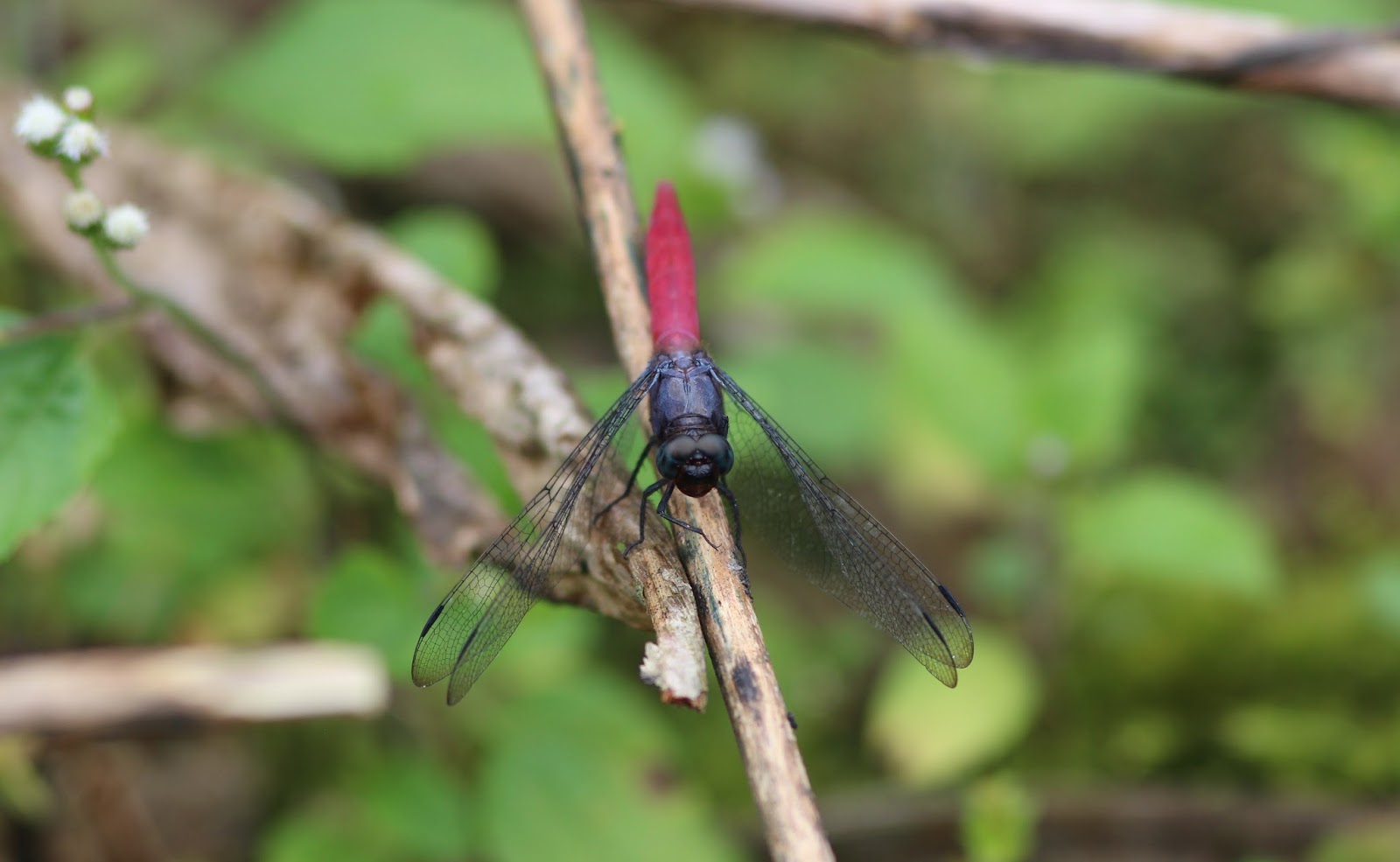
After eating, I venture out and realise its a field day for insects. A crimson-tailed marsh hawk adds extreme pink to the colours on a sunny day, a common gull butterfly sits pretty on a yellow flower, a bee pollinates in exchange for a drink, a jewel beetle walks the tight rope on a thin leaf blade, and a pretty snail decides to do a slow-motion bungee jump with its mucus.


Then it rained again for a week during which the Solung festival happened. The two days following Solung are 'mana' days, days during which it is restricted to do any work. So like a gaulish village on a holiday, the entire village drinks and by noon some are singing, other arguing, others indulged in a game of cards and strangely some even sleep in the noon. On other days sleeping in the afternoon is almost a taboo. I think the point of the 'mana' is just that; few days in the year are reserved for rest since other days are full of hard work for agriculture.


When finally we had few hours of sun one day, everyone was out again. Some kids playing cricket in the field, smaller kids collecting colorful wrappers, and the women playing cards, there is nothing much else to do. But that was a short break and the rains broke out again.


Some more days in the barracks spent, with a loud background of rain falling hard on the tin roof, contemplating the answer to life, the universe and everything. Lonely times in a place with no electricity of internet where the only choice you have are to read or write are rare and I have learnt to savor them, because afterall, things fall in place.


A Siang winter's tale

I have spent five of the last six winters in Upper Siang, Arunachal, and this time I am not there! I keep looking for a fire to warm my hands, legs and my back. Central heating or warm air blowing or warm clothes just doesn't do it for me. In the winters in Bomdo village, everyone huddles up around the nearest fire and chats endlessly, constantly reinforcing the thought that its cold indeed, "anchinga", they'd say. And when some days the sun is out, everyone squats in the centre of the village which is flat and basks and chats.

Some of the best conversations happen around a fire.

Early winter, in November, on sunny days we know exactly what to do. We visit the local swimming pools that are formed along the Siang river. Before November these pools are still connected to the river and later in the winter, these pools are too shallow. Imagine having a natural pool with beautiful rocks and sand with a verdant background you can dip in. My friend Gekut even makes a banana trunk boat in about four minutes and we sail on these pools on the boat. After the cold dip we pick up Taari (Halyomorpha picus, an edible stink bug) from below the rocks on the bank and make a meal of them!

Our private pool along the Siang river bank!
Most days, the cold wakes me up early and the first thing to do is to make a fire. Firewood comes at a premium, during field work, Roy and I would ask our field assistants to pick up dead wood and bring back to the camp. Also we had seven fast-growing neem (Azadirachta indica) trees that were planted about 8 years back, three of which we used over the years we were there for firewood. Each time one of the villager comes to the Inspection Bungalow, they would remark that we always make small fires, 'lakdi ka kanjoos' they'd say!  In return for making a bigger fire, we would ask them to send us some firewood and often they would too!

Woodstock! All Adi homes have firewood stacked up below their houses that are raised on wooden boles or cement pillars.
 
Compare that with our pile of firewood above the stove!

Cooking on firewood in the winter is fun too and we even made a double stove by fixing a broken stove with our main stove using metal wire. 


Almost every evening, my friend Roy and I start a fire and put water to boil in the sootiest blackest kettle you may have ever seen. A small walk to the nearest shop gets us some pocket-friendly rum called 'Amigos', distilled and bottled in Arunachal. Hot water with rum warms our souls and we slowly cook and chat endless hours. The whole process of cooking takes more than two hours and by the time food is ready we are starving. Food tastes ambrosial; hunger tastes better than any elaborate recipe I guess. Anyone who visits the Inspection Bungalow we stay in, in the evening is treated as/with Amigos and food too, but hardly anyone comes in the late evening, since they believe that the bungalow is haunted, which works well for us!

The mandarin oranges fruit in December and we eat them by the hundreds. None of the fruits of trees around the village are actually sold anywhere and anyone is free to pick as many as they like. In the winter, I hear tiny kids climbing the orange trees right in front of the Inspection Bungalow or trying to and as a last attempt even shaking the trees and throwing stones at the fruits, stones which would often land on the roof of the bungalow. Gekut also taught me how to flick the peel in a way in which the peels fly like a frisbee and lands far; best to try this on a hillslope to watch the peel fly away.

Lot of activity happens in the village during winter since it is the best time to travel far from the village into the forests and camp and hunt since in this season, there is less rain, no leeches and no snakes. On the 31st of December we celebrate every year what folks in the village call 'waiting night'! They say that this night is spent 'waiting' for the new year and therefore the name. On this night everyone visits every home where there is a party and wishes them and there is also a lot of dancing. During one such large party, a person from the village who more recently shifted to Yinkiong town for a Government job, announced prizes for school kids who scored well in their exams. People celebrate 'waiting night' and 'waited morning' and 'waited night' the next day of the new year in groups with each person in charge of specific tasks. My task in the two 'waiting nights' I celebrated at Bomdo was to visit Yingkiong, the nearest town, 35 km away on a bike and bring back meat, alcohol and other goodies, not a simple task since it could be raining too and on the way back besides looking like a travelling salesman, there is the risk of things falling out of the bike on the hilly potholed roads.

Most kids love their photograph being taken but someone had scared them saying that when a photograph is clicked they will be trapped in the camera forever, so they don't look happy, especially the young ones!

The first morning of the new year is celebrated on the Siang riverbank and both men and women cook and drink while kids play on the riverbank and most of the men dare to bathe in the shallow parts of the Siang river. I've done this and its shockingly cold, that one dip packs the chill of the entire winter it feels like, but feels great after the initial jolt!


In the party the following night, there are also awards given from the money that is leftover from peoples donations from the parties; 'best dancer', 'best cook', 'best worker' and I am proud to say that I won the 'best bike rider' award of 100 rupees, since I rode back to the village with a very drunk person back from the river bank on the bike making sure he didn't tip over while riding! Every person who gets these prestigious awards does return the money back so more food and alcohol can be bought for the party! This party is definitely worth the 'wait'!

The February rain showers are the coldest and even if one gets used to the winter chill, these showers still make you put bigger logs into the fire. The rains in the region often cause a landslide and electricity is unavailable, for sometimes months.

Taking photographs of raindrops is a nice way of spending time during rainy days when field work is not possible! 

During the winter rains when there is no electricity, we make a fire and read a book beside the fire, or play 'chilo' or 'sepak takrow' with a ball made from bike tube strands in one of the rooms. Gekut here is happy with his shot!

In February, the local raspberry fruits and we eat loads of them but they need to be carefully picked; if you are too greedy you are stung with the thorns of the shrub. Gekut and I often pick these berries and eat and accuse each other of being greedy or 'yeering'. Gekut would say 'No yeering baah', which translates to, 'you are very greedy', while picking off the best raspberries for himself!

Few days in March are actually sunny and with the passing days it gets from warm to hot. Walking in the forests gets sweatier and more leeches welcome you and the weather; you realise that you already miss the winter chill. Winters are simply fun in the Siang valley.

The great crossing

May is not the best month to be around here in Upper Siang Arunachal. The rains that go on for almost the entire month nudge the lands to slide blocking roads, sometimes for weeks on. May this year, however, is even worse. With the Zilla Parishad elections going on here my field assistants don't have the time to tag along for field work, in fact they don't even have time to do their own work. Most of the villagers including the young and old are in high spirits through the day and often through the night. But thats a story for another time. Today was a day Roy and I were going to reach the Bomdo village from the Yingkiong town, the headquarter of the district, a distance of only 35 km. But there was a river to be crossed, the teeming Siang river. And we could see the rain approaching us two hills away.

The rain approaching us two hills away (Photo by Anirban Datta-Roy)

Usually we use the Gandhi bridge to cross over on a bike but today there was a landslide on the road to the bridge and we had to use the ferry. When we got on to the ferry, the rain had started as a slow drizzle and we expected a major downpour which would make reaching Bomdo slightly more uncomfortable. We were the first to arrive and the boatmen had to wait for few more bikes and at least two cars. So I waited, taking in the view, ahead at 11 O'clock a major rain approaching us seeping in between two hills, at 3 O'clock the groggy Gandhi bridge and at 8 O'clock a sandpiper on the sandbars on the bank of Siang. Thats when the loudspeakers on the ferry poured out "take it easy, take it easy, don't let the sound of your own wheels drive you crazy". In a moment I was teleported to a city, like in a pub on a rainy day in Bangalore. The folks in front of me opened up their beer bottles and started sipping, it was the election surplus. What was nice was that everybody on the ferry knew each other, so they kept sipping from the same bottle without ever so much as asking whether they could indulge.

Slowly, there were more bikes followed by a clamour from the folks on the boat directing how the bikes had to cross on the wooden planks from the bank to the ferry, for, earlier in the day one bike had slipped and fallen in the sand, a good 2 m fall. The ferry would not leave soon since the folks boating the ferry were waiting for the wind to subside. Thats when a gypsy arrived full of policemen who were visiting remote villages in the Upper Siang district on election duty. One of them was a new recruit who had exchanged election duty with a friend who was to go to the Geku village, further downstream and far less remote, for Singa village, perhaps the most remote village in the district, much to the humour of his colleagues. His choice though was wise, its a beautiful trek with stunning views of snowy peaks of Upper Siang and Upper Dibang valley districts. To get to Singa, one needs to get to Tuting town from Yingkiong, a distance of about 180 km which is a 12 hour drive and then a three day 50 km walk to the village from Tuting along the Yang Sang Chu (river). Singa is the last village in this district, bordering the Upper Dibang valley district.

The beautiful view on the way to Singa

The new recruit was very chatty and was an adventure guide earlier and knew quite a bit about rafting. He had also bought new shoes and knew they would only last the to-and-fro trek from Tuting to Singa. After a while, a pickup slithered down the muddy track to the ferry and boarded the ferry. On the pickup were more election goodies; at least ten crates of alchol, and a huge fat pig tied up upturned. So in all, there were about ten bikes, three cars, about twenty of us and one pig. The boatman then lit a beedi to judge the wind and gave the final ahoy and we crossed over the river in about five minutes.


To our luck, the rain too changed direction and we reached Moying a small settlement on the right bank of Siang. We left for Bomdo chuckling that the folks in the pick-up picked up few more crates of alcohol.

Against all odds


The Yellow-throated Marten is called 'Sikki' by the Adis here in the Upper Siang district. Today, I went to a a shifting cultivation field that was abandoned 50 years back and saw several large trees. Almost as many as I saw earlier in the adjoining patch which was cultivated 100 yars ago and abandoned. Field work this time was logistically tough Align Leftsince February-end/March is the beginning of the agriculture cycle and everyone is busy. To top that, the day I landed here, there was a festival called 'Mithun' puja, when Mithuns, the feral cattle here, are sacrificed and the meat is distributed among the clans. If they talk to any outsiders, referred to as 'Ayings' here, their Mithuns and pigs may get killed by wild animals. And one last detail that affects the logistics of my field work; its raining cats and dogs here, in February, which is quite early, too!

So three days later, things turned out this way. Due to the rains, the festival was cancelled and therefore I could meet people without causing any risk to their livestock and the sun generously came out yesterday and ahoy field work could finally begin. This time, I am here at Bomdo  to enumerate trees in different-aged abandoned shifting cultivation fields, which brings me right back to the martens. I was tired after the first field day after several months and was wondering why I chose such a remote and difficult to work in place. I took a few more heavy steps and heard movement in the undergrowth. This was so close to the village and at mid-day that I was expecting domestic pigs. But they were martens, which lifted my spirits right up! One runs away, the other chases, the third, while passing turns around for a second or two and gives me a 'what are you doing here' look. My field assistant Durik told me that they were probably fighting and that martens are against odds. Let me explain what he told me in a bit more detail!

The Adis think/know that martens are never happy in groups of 3, 5, 7 and so on. If there are 3 or 5 or 7, one will get definitely killed by the others! So I asked Durik if anyone has seen this happening and he said many people have and that they know this for sure! And people from another village down the Siang river, Ramsing, told me the same too. Wonder what is going on! Another detail is that they never eat the marten meat here, but they do kill it when they see one, since martens kill chicken in the village. Anyways, for me after a tiring day in the field, I was happy to see three, although perhaps fighting with each other or more likely playing with each, martens!

Rains reign

In the Upper Siang district, it rains more than 4 metres a year...picture that for a second. 

And there wasn't a month without rain in the last year I visited. Often it is disappointing if I have planned out some work for the month. But its also fun jumping in giving in to the ways of nature.

So this time it happened like this; Roy and I had to reach Bomdo from Jengging but it had already started raining for days. I remember reading in a John Steinbeck book about a character who could describe ten or more different kinds of rain, all of which he found annoying. There is only one kind of rain here; hard rain which takes breaks to drizzle before it brings along a landslide often followed by a roadblock. But I had to get back equipment to return to the institute I was leaving to get the 'no due' certificate and had brought a crank radio and few cds for some of the villagers. So I waited two days, no break in the rain.


Then morning before yesterday's we left...rain or no rain, had to finish the chores. 10 am we left on a bike from Jengging and rode continuously for three hours to get to Bomdo, 70 km away. Once we reached Gekut's house in Bomdo, he quickly popped some corn and brewed some black tea. The thing about riding in the rain is that it is all fine till one has to stop.  The time I stopped at the village after the cold ride I could not stop shivering for a long time! At one point I had to pee (locally referred to as 'minus'!) and my hands were too numb to even feel the trouser button, was a struggle! 

After collecting the equipment and bidding our byes, the next stop on the return was Ramsing village 30 km away. The home that we stopped briefly at I asked for some rice wine to warm us up and then headed back to Jengging to reach at 6 pm. Got back, took a hot water bath and all good things followed including writing an ode to Jengging!

During the two days of waiting for this trip, I spent some time photographing waterdrops; this is the best thing you can do when its raining continuously and better still if you have a 500 mm lens...those drops of rain are sprinkled around on the blogpost.